



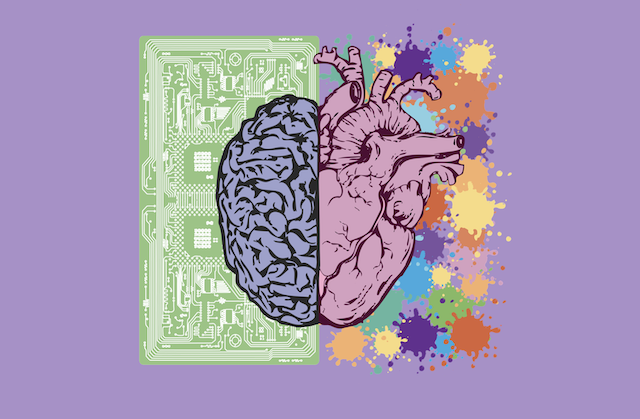
We all use common idioms to describe how something negative lands on the body.
“He’s got the weight of the world on his shoulders,” we say. Or, “She had her heart broken.” We blame others for worrying us into a stomachache.
And who hasn’t accused people of being a pain in the neck — or another region?
Tell anyone something tragic or awful, and almost instinctively, they’ll put their hand to their chest as if to protect against heartbreak.
As I continue to gravitate from bodywork toward mental health care, I’m more convinced that what happens emotionally lands on us physically.
Identifying the source of pain
Pain is a tool the body uses to alert us to something that needs attention, and you should never ignore it. If you’re experiencing pain or other symptoms, it’s best to see a health care professional.
In many instances, we can immediately identify the source of pain. For example, we strain a muscle at the gym, slip on the ice and sprain our ankle, or throw out our back helping a friend move — and find ourselves in acute pain.
Typically, there’s swelling, redness at the site, and throbbing that can be relieved with a traditional RICE remedy — rest, ice, compression, and elevation.
Importantly, acute pain keeps us from getting hurt even more. If your knee is acting up, it might be best to skip your run for the day because if you decide to mask the pain with Ibuprofen, you could worsen an injury.
Then there’s chronic pain, which may be associated with medical maladies from arthritis to cancer. Unfortunately for chronic sufferers, pain management may not eradicate pain but keep it at a certain level. As a result, chronic pain sufferers commonly admit they live with the pain or ignore it altogether. Clients say they “push through.”
But what happens when there’s no apparent source for chronic pain?
Is the pain in your neck all in your head?
No one wants to feel like a hypochondriac or, God forbid, be dismissed as one. However, pain does happen without an identifiable origin.
After 26 years of practicing massage therapy, I know that a great deal of pain in the neck (and everywhere else) comes from something other than injury or disease.
Stress is a significant factor. For example, a migraine headache may signal excess stress. I’ve seen countless cases where the source of pain or discomfort had roots in the emotional. It’s one of the main reasons I shifted from massage therapy to psychotherapy.
I recall a client whose child was diagnosed with a grave illness. This father suddenly got debilitating plantar fasciitis preventing him from working as usual — a blessing in disguise because he really needed that time to care for himself and support his family.
Another client suffered daily migraines; once she left the controlling relationship she had been in for years, the migraines dissipated almost overnight.
Chronic pain can also indicate a past, unaddressed hurt — trauma, abandonment, bullying.
In high school, I was the victim of some pretty severe bullying. I also suffered constant back pain that frequently kept me home from school. I look back at the pain; it was real, but there was no physical cause.
Years later, chronic pain returned in a different situation where I felt unjustifiably attacked. I finally realized that unaddressed emotional distress was manifesting itself as physical pain. So, I treated the pain by being honest and talking about it.
In truth, pain is all in your head because that’s where your brain is. The neural pathways that fire when your brain perceives physical pain have some actual overlap with the pathways associated with stress and emotional distress.
What’s more, when such experiences recur, it’s easy to fall into those well-worn neural pathways. Something to ponder the next time your back “goes out” for no reason.
The body is definitely keeping tabs
Without a specific medical diagnosis, it may be hard to dig deeper and decipher the message our bodies send. But answers are there; the body is definitely keeping tabs.
Some people heal through journaling. Others need to talk it out on long walks with trusted friends. Maybe you need a little help from a mental health professional.
Trust the messages your body sends and allow those hurts to come out so their power over you may begin to diminish.
Listen. Breathe. Be honest with yourself — no small task, I know.
Feel better.
Kathleen Lynch is a Clinical Mental Health Counselor who approaches her work from a holistic point of view. She is also a Certified Personal Coach and Licensed Massage Therapist and has practiced coaching for many years in conjunction with massage therapy. She contributes this column, Feel Better, in exchange for a listing in our Island Directory. Kathleen’s work focuses on the negative effects that stress and poor mental health can have on the body. She lives on Shelter Island with her husband and has a private practice in her home. For more information, you may contact her through her website at timefortherapy.org.